L.A. Officials and Climate Experts Clash Over Whether the City's 2030 Emissions Targets Are Achievable
With deadlines closing in and sprawl still defining the city's DNA, the debate over Los Angeles's carbon goals is getting loud.
With deadlines closing in and sprawl still defining the city's DNA, the debate over Los Angeles's carbon goals is getting loud.
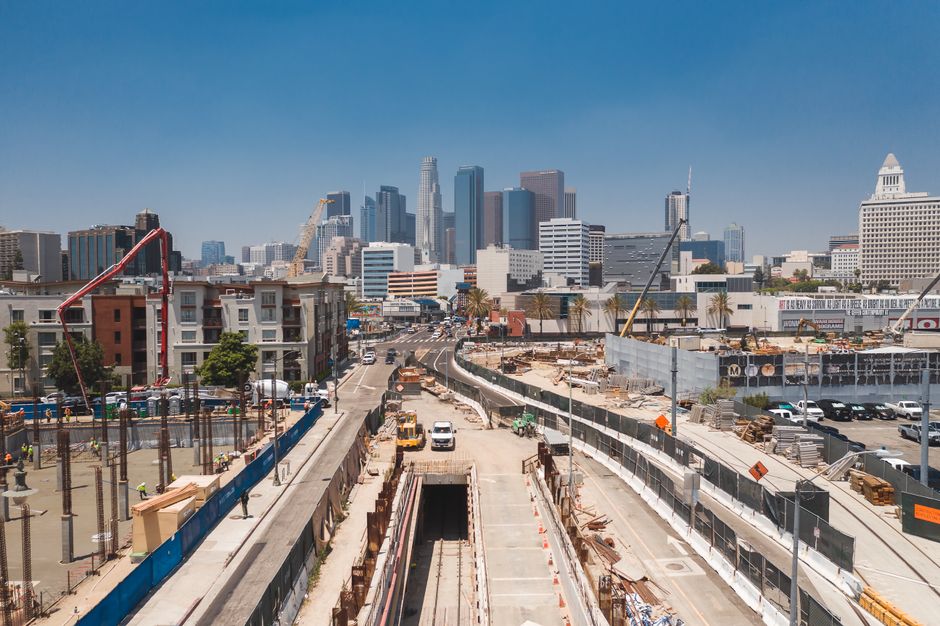
Los Angeles has committed to cutting greenhouse gas emissions 50 percent below 1990 levels by 2030 — a target city officials publicly defend as reachable but that a growing number of urban planning experts and transportation researchers say is structurally undermined by a metro area built almost entirely around the car. The argument, once polite, has turned pointed.
The timing matters. With the 2028 Summer Olympics bringing an estimated 15 million additional visitors to the region over a three-week period, city planners are under simultaneous pressure to decarbonize infrastructure and massively expand it. Every freeway lane-mile added and every temporary venue constructed carries a carbon cost that shows up in the city's own accounting. That tension is forcing a harder look at whether L.A.'s climate math adds up.
The Los Angeles Department of Water and Power, which serves roughly 4 million customers across the city, is pointing to its Green LA Action Plan as evidence of genuine momentum. The utility has said it wants to reach 100 percent renewable electricity by 2035, five years ahead of the state mandate under California's SB 100. Officials at the department's North Hollywood headquarters have emphasized investments in battery storage along the Tehachapi transmission corridor and expanded rooftop solar incentive programs in the San Fernando Valley, where adoption has lagged compared to wealthier Westside neighborhoods.
At City Hall on Spring Street, Mayor Karen Bass's office has tied emissions progress to her ongoing housing emergency declaration, arguing that building dense transit-oriented housing near the Metro E Line extension in West Santa Monica and along the Crenshaw/LAX Line corridor reduces vehicle miles traveled per resident. Her infrastructure team has cited modeling suggesting every 1,000 units of housing built within a quarter mile of a rail station removes roughly 2.4 million vehicle miles from the road annually. Critics note that modeling assumes occupancy patterns and transit usage rates that Los Angeles has historically never hit.
Alex Villanueva, the former Los Angeles County Sheriff who has since moved into environmental policy advocacy, has been publicly skeptical about the pace of EV charging infrastructure buildout in the eastern San Gabriel Valley, where lower-income households cannot easily access home charging. The L.A. County Electric Vehicle Charging Infrastructure Assessment released in March 2026 found that unincorporated communities east of El Monte had fewer than 1.2 public Level 2 chargers per 1,000 residents — roughly one-quarter the density found in Santa Monica.
Researchers at UCLA's Luskin School of Public Affairs have been circulating internal analysis suggesting the city is on pace to achieve roughly a 31 to 34 percent emissions reduction by 2030 under current policies — meaningful progress, but well short of the 50 percent target. The gap, they argue, sits almost entirely in the transportation sector, which accounts for approximately 47 percent of L.A.'s total greenhouse gas inventory.
The South Coast Air Quality Management District, whose jurisdiction covers Los Angeles, Orange, Riverside and San Bernardino counties, reported in its 2025 Air Quality Management Plan that mobile source emissions — cars, trucks and buses — declined only 8 percent between 2015 and 2024, even as EV registrations climbed past 600,000 countywide. The problem is total vehicle miles traveled, which rose 4 percent over the same period as the region's population and warehousing activity expanded.
Climate consultant groups working with the Los Angeles Cleantech Incubator in the Arts District have argued the city needs a congestion pricing program similar to what New York launched on the central business district in 2024 — applied specifically to the 405 and 101 freeway corridors during peak hours — to generate both revenue for transit expansion and a genuine behavioral shift away from solo driving.
The next formal checkpoint comes in September 2026, when the city is required under its own Climate Emergency Mobilization Office ordinance to submit a revised implementation report to the City Council's Environment and Homelessness Committee. That report will either defend the 2030 target or quietly revise it. Planning department staff have already begun briefing council members in private sessions, according to people familiar with those meetings. How those conversations land will determine whether Los Angeles holds the line on what it promised — or starts explaining why it couldn't.
How does this story make you feel?
Spread the word
About this article
Published by The Daily Los Angeles
Daily brief
Free, in your inbox before 7am. Weekdays.
More in News